
Criminal Cases in the Monroe County Courts
Monroe County divides criminal cases by court level. General Sessions Court hears misdemeanors and handles warrants, bond, and preliminary hearings in felony matters. An indictment moves a felony into Criminal Court, where arraignment, motions, a plea or trial, judgment, and sentence become part of the case file. The Monroe Circuit Court Clerk serves both courts. That uncommon arrangement gives a searcher one local custodian for the two main state criminal dockets.
The clerk works from Suite 4 at the Monroe County Justice Center, 4500 New Highway 68, Madisonville. Circuit and Criminal Court questions use 423-442-2396. General Sessions and Juvenile questions use 423-442-9537. Sweetwater, Madisonville, Vonore, and Tellico Plains municipal courts keep their own ordinance and citation dockets. A city citation is not automatically a Monroe County criminal prosecution, so read the named court before choosing a counter.
Monroe County Court Roles by Charge
The filing path explains where a Monroe County court record should appear. General Sessions can resolve a misdemeanor, but its felony role is preliminary. A grand jury decides whether probable cause supports an indictment. Criminal Court then owns the indictment-level proceeding. Juvenile matters use the same justice complex but are restricted and should not be treated as ordinary public criminal files.
| Court or office | Record role | Verified contact |
|---|---|---|
| Criminal/Circuit Court | Felony case files after indictment | Suite 4, 423-442-2396 |
| General Sessions | Misdemeanors and early felony stages | Justice Center, 423-442-9537 |
| Juvenile Court | Restricted juvenile matters | Justice Center, 423-442-9537 |
| Municipal courts | City ordinance and citation dockets | Contact the named city clerk |
A state-law arrest may start with city police but still reach Monroe General Sessions. The badge identifies the report custodian. The court and case number identify the docket custodian.
How to Search Case Records
The free Monroe clerk search landing page offers a public criminal query without an account. Start with a case or citation number when one is known. A name can be paired with date of birth or a narrow filed-date span to reduce false matches. The separate officials and attorneys login is not required for public use.
- Open the clerk search and choose Criminal Search.
- Enter the most distinct known value, such as the case number, citation, or name plus birth date.
- Add a filed-from and filed-to range if a common name returns too much.
- Select Search, then use the plus control beside a result to open its docket.
- Call the proper clerk line for an older file, a portal miss, or a certified copy, and verify any current fee before ordering.
| Field label | Type | Required | Format or use |
|---|---|---|---|
| Case # | Text | Unspecified | No local pattern is posted |
| Name | Text | Unspecified | One field, not split first and last |
| Alias | Text | Unspecified | Separate alias query |
| Citation | Text | Unspecified | Citation number |
| System Wide Search | Text | Unspecified | Scope is not explained |
| Date of Birth | Date | Unspecified | M/d/yyyy, minimum 1/1/1900 |
| Filed From / To | Date | Unspecified | Beginning and ending filing dates |
The public portal is the quickest index, not the only access channel. A reader may call the clerk, visit the Justice Center counter, or ask how to obtain a paper or certified copy. The office publishes no current copy fee or firm processing time, so confirm both before submitting an order. When the division is unclear, explain whether the case began as a misdemeanor, felony complaint, indictment, or city citation. Staff can then direct the question to the correct docket.
Monroe County Docket Portal Limits
The public Monroe County search proves that a result has a case number and an expandable docket. It does not promise downloadable trial documents, a full financial ledger, bond data, counsel fields, or the same detail for every era. An empty search is not proof that no case exists. Spelling, aliases, filing lag, an old file, or the wrong court can all explain a miss.
The interface still displays a 2020 COVID suspension notice. That banner is old residue, not proof that the clerk is closed now. Use the current clerk contacts before travel. For scheduled matters, the office also posts separate General Sessions dockets and Circuit Criminal dockets. Calendar pages help locate a hearing, while the criminal search follows the filed case.
Note: A portal result is an index and docket trail; ask the Monroe County clerk which original or certified document answers the question.
What the Case File Shows
A Monroe County case file centers on the prosecution, not the jail intake. Read each charge row on its own because one count may be dismissed while another ends in a guilty plea. The docket's order also matters. It can show when the complaint, indictment, plea, judgment, or later motion entered the file, but only the final disposition establishes the outcome.
| Case number and court | Identifies the docket and whether General Sessions or Criminal Court holds it. |
|---|---|
| Charging document | A complaint starts lower-court work; an indictment formalizes a grand-jury felony charge. |
| Docket entries | The dated sequence of filings, hearings, process, motions, pleas, and orders. |
| Hearing dates | Scheduled or completed court events, subject to later change. |
| Disposition and judgment | The result for each charge, such as dismissal, nolle prosequi, acquittal, or conviction. |
| Sentence and conditions | The court's order after conviction, including confinement or probation when stated. |
The arrest label can change before indictment and again before judgment. Compare it with the filed charge rather than assuming all three stages match.
Monroe County Docket Terms Explained
Tennessee docket language can compress a major event into a short phrase. A few plain meanings prevent the most common error: reading a procedural step as a conviction. The Monroe County clerk can provide the filed order when an entry remains unclear.
- Arraignment
- The hearing where the formal charge is presented and a plea is addressed.
- Nolle prosequi
- The prosecutor formally elects not to proceed with a charge at that time.
- No true bill
- The grand jury declines to indict on the proposed charge.
- Capias
- Court process that commands arrest, often after a failure to appear or comply.
- Disposition
- The outcome of one charge or the case.
A dismissal, nolle, no-bill, or acquittal is not a conviction. An active docket has no final result yet. A guilty plea or guilty verdict supports a conviction entry once judgment is filed.
Stages of a Criminal Case
Monroe County felony work often begins in General Sessions before a grand-jury decision sends an indictment to Criminal Court. Misdemeanors may remain in General Sessions. The charging office for District 10 reviews state prosecutions, while the clerk preserves the public court trail. A plea can end the case before trial, and an appeal creates a separate appellate record.
Case flow: Charges Filed › Arraignment › Pretrial › Plea or Trial › Disposition › Sentencing
The Monroe County Sheriff Court Services Division screens the justice center, secures courtrooms, and transports detained people to hearings. Those custody movements are operational records, not substitutes for the clerk's motions, judgments, and sentence orders.
Monroe County District 10 Charging Path
Monroe County belongs to Tennessee Judicial District 10 with Bradley, McMinn, and Polk counties. The current District Attorney General's office identifies Stephen Hatchett and a Monroe Criminal Office at 310 Tellico Street, Suite 2, Madisonville, 423-442-7404. The county judicial directory still names a former district attorney, so the District Attorneys General Conference is the sound source for the current prosecutor.
The prosecutor's office evaluates and presents charges, but it is not the case-copy counter. The District Public Defender represents eligible people appointed through court and is also not a general records custodian. Monroe County case copies stay with the Circuit Court Clerk. This separation helps avoid sending a docket request to an office that litigates the case but does not maintain the public file.
Access & Restrictions
Tennessee Supreme Court Rule 34 starts with public access to filed case records, but law, a sealing order, a protective order, or a stated judicial-function exclusion can limit it. Juvenile cases, sealed or expunged files, victim-sensitive material, protected identifiers, and parts of an active matter may be hidden or redacted. Judge-use copies, drafts, deliberative notes, and internal case-management material are not necessarily public case records.
Call Suite 4 before requesting older or certified Monroe County files because no current copy or certification fee is published in the source set. Give the case number, court, party name, and approximate filing year. If a city court handled the citation, request that municipal docket instead of asking the county clerk to recreate it.
Monroe County Appeals and Expungement
An appealed Monroe County criminal case can create a record in Tennessee Public Case History. That system covers appellate cases, not the full Monroe trial docket. Its structure may show a Case Overview, milestones, parties, document history, trial-court details, and some permitted post-2013 PDFs. It covers appeals filed after September 1, 2006 and is current through the prior business day. The official appellate interface can be seen through the Tennessee Public Case History source.
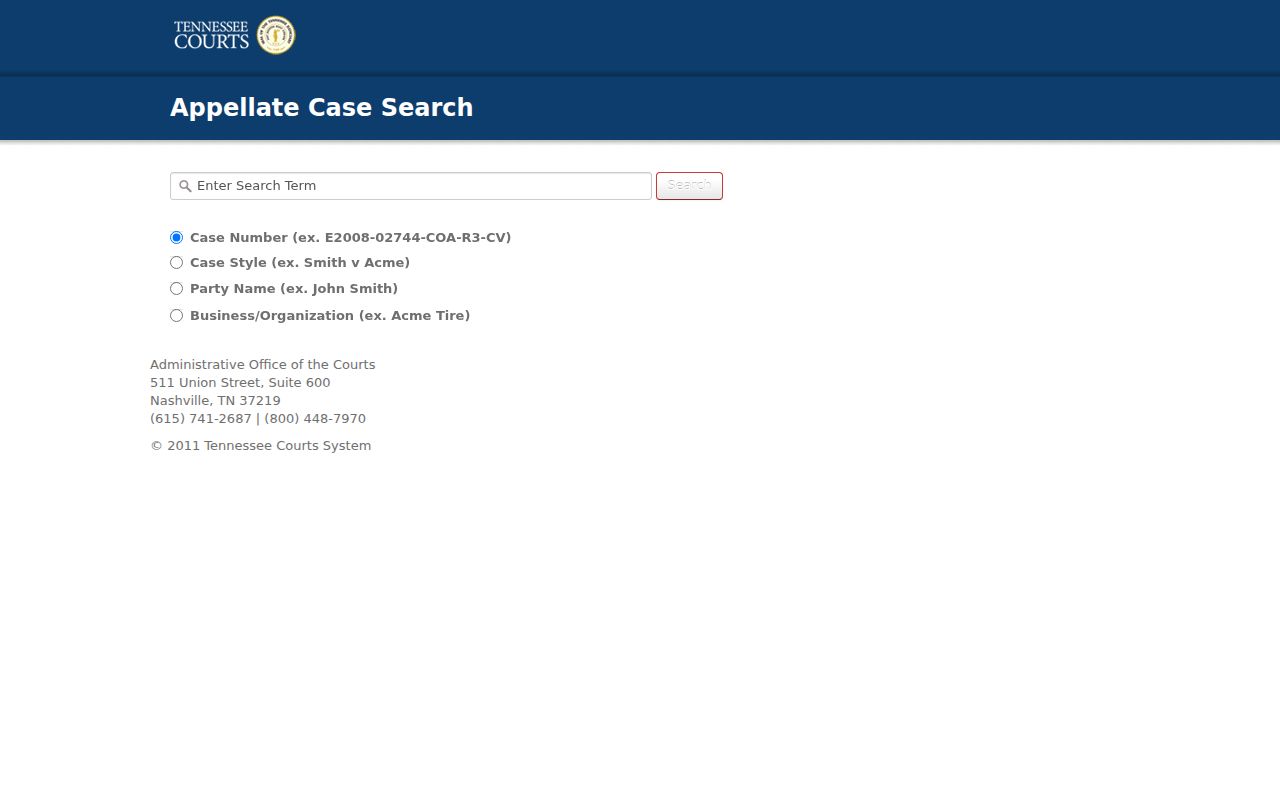
This screen belongs to the appeal layer, so a missing result should send the searcher back to the Monroe County trial-court portal and clerk. For an eligible dismissed or resolved charge, file for expungement in the originating Monroe court. The Tennessee courts expungement guide explains no-cost outcomes such as dismissal, no true bill, not guilty, or nolle prosequi and the different rules for eligible convictions. Keep the certified order and charging document after relief is granted.
The official process and forms are illustrated by the state expungement resource.
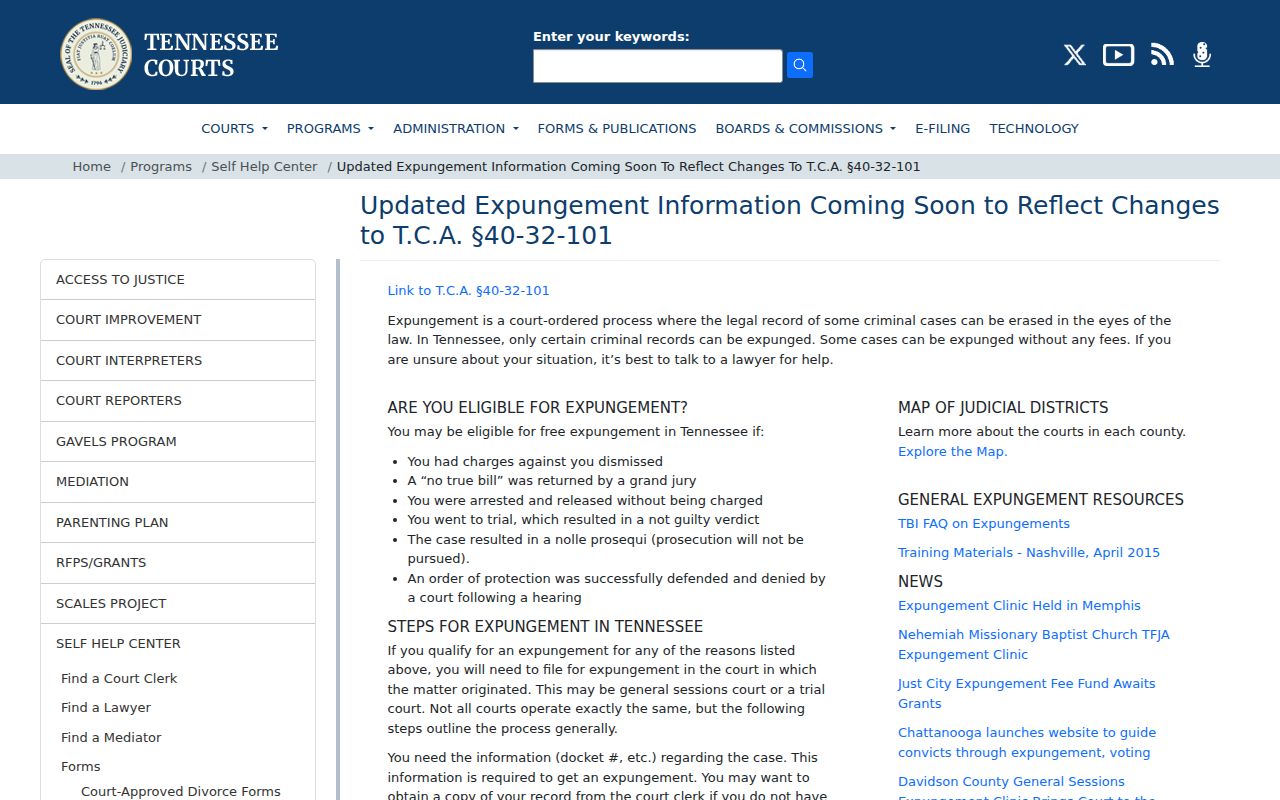
The court sends a completed order to record holders, but a certified copy gives the person a lasting way to address a record that remains visible.